Kapuas River Tours, Kalimantan Tour Operator & Adventure Tour Specialist,Pontianak along the Kapuas River, Tours in to the wild jungle, Dayak Longhouse Safari,borneo,flight,reservation,book,hotel,room,airline,ticketing,camp,Expeditions

Kalimantan Tour Operator in Indonesia, is able to serve your Golden Traveling Routes to the Deep Hinterland of Mystic Borneo / Kalimantan Island, as Jungle treks, Dayak indigenous Culture, Adventure trips in area's as the Apokayan, Kayan River, Mahakam River, Barito River, Rungan River, Kahayan River, Katingan River, Kapuas River, Mount Meratus, Kutai Reserve, Kayan Mentarang Reserve, Tanjung Puting Reserve, Camp Leakey, Orangutan tours, Tangiling National Park, Gunung Palung National Park, Danau Semantrum National Park, Kersik Luwai Reserve, Diving at Derawan Islands, Longhouse Tours, Dayak Hunting Tours, Mahakam Dolphin Tours, Orangutan safari,Safari, Safari Tours, Safari Tour, Adventure Tour, Adventure Tours, Adventure expedition, Adventure Expeditions, Expedition Tours, Expedition tour, Expeditions tour, trip, trek, trekking, Adventure trek, Adventure trekking, Adventure trips, jungle trek, jungle treks, jungle trekking, jungle trekkings, jungle tour, jungle tours, jungle adventure tour, jungle adventure tours, rain forest trek, rainforest trekking, rain forest trekkings rain forest tour, rain forest tours, rain forest adventure tour, rain forest adventure tours, rain forest expeditions, rain forest adventure expedition tours, wild life adventure, wild life tour, wild life tours, wild life expedition, wild life expedition tours, bird tour, bird tours, wild life safari, wild life safari tour, wild life safari tours, safari trip, , travel to Kalimantan, travel to Borneo, wild life travel, adventure travel, expedition travel, traveler, traveling, touring, tourism, backpack tour, backpack tours, backpacker tour, backpacker tours, backpacker expedition, backpacker safari, backpacker traveler, backpacker traveling, of the beaten track tours, of the beaten track expeditions, of the beaten track travel, of the beaten track safari, of the beaten track expedition, Kalimantan of the beaten trek, of the beaten trek, of the beaten trek tours, of the beaten trek adventure, Kalimantan of the beaten track, itineraries, itinerary, tour program, tour programs, pax, travel compagnion, travel friend, cross the border of Malaysia to Indonesia, cross the Kalimantan Border, cross the Borneo border, Tawau to Nunukan, Tawau to Tarakan, cross the border tawau, cross the border Nunukan, cross the border Long Bawan, cross the Border Entikong, fly, flights, airlines, Hotel, Hotels, tour reservation, tour operator, Kalimantan tour operator, Borneo tour operator, eco tourism tour, eco toursim tours, eco tour, eco tours, ecotourism, tours to Sabah, Sarawak etc, etc. Hotel bookings, Taxi / Car rental service, Boat rental, Flight bookings and a lot more can be arranged.
          Kalimantan Tour Operator in Indonesia,serve Traveling Routes to the Deep Hinterland of Mystic Borneo / Kalimantan Island, as Jungle treks, Dayak indigenous Culture, Adventure trips in area's as the Apokayan, Kayan River, Mahakam River, Barito River, Rungan River, Kahayan River, Katingan River, Kapuas River, Mount Meratus, Kutai Reserve, Kayan Mentarang Reserve, Tanjung Puting Reserve, Camp Leakey, Orangutan tours, Tanggiling National Park, Gunung Palung National Park, Danau Semantrum National Park, Kersik Luwai Reserve, Diving at Derawan Islands, Longhouse Tours, Dayak Hunting Tours, Mahakam Dolphin Tours, tours to Sabah, Sarawak etc, etc. Hotel Reservations, Taxi / Car rental service, Boat rental, Flight bookings we can help to create your own Kalimantan tour program. Covering Whole Indonesian Borneo. Programs are Culture, Nature, and Adventure or a combination of it. Our standard programs can be found at Tour Programs Site from where you can choose a Kalimantan tour package or make a combination of two or more Kalimantan packages. Our Kalimantan Tour Packages covering whole Borneo.For Information crossing the borders between Sabah or Sarawak to Indonesian Kalimantan. Now Kalimantan is crisscrossed by giant rivers including the Mahakam River, Barito River, Kapuas River,Kahayan River,Sekonyer River,Kayan River,Katingan River,and the Belayan River. A wide variety of montane and lowland rainforest, each an important genetic resource and wildlife habitat. More then a half of the hard wooden tree species are found only at Borneo, climbing rattan palms, vines, orchids, ferns, and pitcher plants common.The wildlife is unusually diverse, wherever you go animal sounds will follow,with luck you might see several species of monkeys, gibbons, wild ox, wild cats, flying lemur, martins, weasels, fresh water dolphins, orang utans, sun bear, leopard, snakes, hornbill birds, parrots, parakeets, and crested fireback pheasants.many kinds of beautiful butterflies and metallic beetles, poisonous polypods, brightly colored millipedes, giant walking sticks, but don’t forget the mosquitos and leeches and the more dangerous bees.The population of Kalimantan is diverse, cause of the booming oil, coal, gold and timber industry, many Indonesians came to Kalimantan searching for work in the last two decades. The native Dayak people live deeper inland along the river banks throughout the interior of Borneo,each Dayak tribe about 200 Dayak tribes have it’s own dialect and culture, thriving as hunters and gatherers. Other Indonesians call the Dayaks stupid men considering them backward because of headhunting and other animist customs. The truth is that they are scrupulously honest by nature, though exposure to Christianity and modern values has muted this trait. Due airstrips and boat connections the Dayak territory is still some of the most inaccessible on earth.Headhunting officially doesn t exist in Kalimantan anymore, though isolated jungle beheadings are still reported as a symbol par excellence of the procreative power of nature. Common interpretations in anthropology agree that nearly all the Dayaks tribes, are of a larger more common Austronesian migration from Asia, regarded to have settled in the South East Asian Archipelago some 3,000 years ago. The main Dayaks are the Bakumpai and Dayak Bukit of South Kalimantan, The Ngajus, and Baritos of Central Kalimantan, Benuaqs,Kayan and Kenyah of East Kalimantan, and the Ibans of West Kalimantan and Malay Borneo, Other populations are the nomadic Punan, which are live nowadays along the Border between Kalimantan and Sabah / Sarawak.Coastal populations in Borneo are largely Muslim in belief, however these groups (Ilanun, Melanau, Kutai) are generally considered to be Islamized Dayaks, native to Borneo, and governed by the relatively high cultural influences of the Javanese Majapahit Kingdoms and Islamic Malay Sultanates, periodically covering South East Asian history.Traditionally, Dayak agriculture was based on swidden rice cultivation. Agricultural Land in this sense was used and defined primarily in terms of hill rice farming, ladang (garden), and hutan (forest). Dayaks organised their labour in terms of traditionally based land holding groups which determined who owned rights to land and how it was to be used. Nowadays, the Dayaks work in the mining industry, wood industry, and plantations of Borneo.The Dayak indigenous religion is Kaharingan a form of animism which is categorized as a part of Hinduism in Indonesia. The practice of Kaharingan differs from group to group, and for example in some religious customary practices, when a noble (kamang) dies, it is believed that the spirit ascends to a mountain where the spirits of past ancestors of the tribe reside. The most salient feature of Dayak social organisation is the practice of Longhouse domicile. This is a structure supported by hardwood posts that can be hundreds of metres long, usually located along a terraced at the river bank. At one side is a long communal platform, from which the individual households can be reached. Longhouses have a door and apartment for every family living in the longhouse. For example, a Longhouse of 200 doors is equivalent to a settlement of 200 families.Headhunting was an important part of Dayak culture, there used to be a tradition of retaliation for old headhunts, which kept the practise alive. Reports describe Dayak War parties with captured enemy heads. At various times, there have been massive coordinated raids in the interior, and throughout coastal Borneo.Metal-working is elaborately used for making mandaus ( machetes ). The blade is made of a softer iron, to prevent breakage, with a narrow strip of a harder iron wedged into a slot in the cutting edge for sharpness. Under Indonesia's transmigration programme, settlers from densely-populated Java and Madura were encouraged to settle in the Kalimantan provinces, but their presence was, and still is, resented by Dayaks, Banjars and local Malays . The large scale transmigration projects initiated by the Dutch and continued by the current national government, caused widespread breakdown in social and community cohesion during the late 20th Century. The systemic and violent attacks on Indonesian Madurese settlers, including mass executions of whole Madurese transmigrant communities. Kutai National Park is a lowland forest area with a number of principal vegetation types, including coastal/mangrove forest, freshwater swamp forest, kerangas forest, lowland flooding forest, ulin/meranti/kapur forest, and mixed Dipterocarpaceae forest. This Park is also part of the largest relatively pristine ulin forest in Indonesia.Among the plants that grow in this Park are mangrove (Bruguiera sp.), cemara laut (Casuarina equisetifolia), simpur (Dillenia sp.), meranti (Shorea sp.), benuang (Octomeles sumatrana), ulin (Eusideroxylon zwageri), kapur (Dryobalanops sp.), 3 species of rafflesia, and various orchid species.An ulin tree in Sangkimah has a height without branches of 45 m, a diameter of 225 cm or a circle of 706 cm, and a volume of 150 m3. It is the highest and largest plant recorded in Indonesia.As well as a variety of plants, this Park also has a high animal diversity. Primate groups like orangutan (Pongo satyrus), Mueller's Bornean grey gibbon (Hylobates muelleri), proboscis monkey (Nasalis larvatus), long-tailed macaque (Macaca fascicularis fascicularis), maroon leaf monkey (Presbytis rubicunda rubicunda), white-fronted leaf monkey (P. frontata frontata), pig-tailed macaque (Macaca nemestrina nemestrina), and slow loris (Nycticebus coucang borneanus) can be found in Teluk Kaba, Prevab-Mentoko and Sangkimah. Ungulate groups like banteng (Bos javanicus lowi), sambar deer (Cervus unicolor brokei), barking deer (Muntiacus muntjak pleiharicus), and lesser Malay mouse deer (Tragulus javanicus klossi) can be found throughout the Park area.Carnivore groups such as sun bear (Helarctos malayanus euryspilus) and flat-headed cat (Pardofelis planiceps) can be found in Teluk Kaba, Prevab-Mentoko and along the Bontang-Sangatta road.Teluk Kaba in Kutai National Park is the location of the nation's third orangutan rehabilitation centre.Kaba Bay and Muara Sangkimah: marine tourism and observing animals, especially orangutans, proboscis monkeys, sambar deer, lesser mouse deer, sun bears, and birds.Lombok Bay and Muara Sungai Sangatta: marine tours and observation of original mangrove forest.Prevab-Mentoko: research; watching animals such as sun bears, orangutans, lesser mouse deer , and wild pigs.Kayan Mentarang National Park covers an area of 1,600,000 ha and is located in the far interior of East Kalimantan province. The park comprises the largest remaining block of rainforest in Borneo and as such forms a very important refuge for numerous species, including many species that are endemic to the Bornean mountain bioregion. About half of the reserve consists of species-rich dipterocarp lowland and hill forest while mountain forest ranges up to Kayan Mentarang's highest mountain at 2,000 m. 40 Percent of the park has an elevation above 1,000 m.The park is inhabitated by several thousand Dayak and Punan people who live from shifting cultivation and rice farming. Wildlife is hard to see due to hunting by native Dayaks.WWF has been working on developing eco-tourist projects in cooperation with the local people. It has 5 field-offices in settlements around the park, which are helpful for information. It also has a research station at Long Alango, north of Long Pujungan, which can be visited, and is probably the best place to see wildlife.Access Kayan Mentarang National Park is very remote and only accessible by public flights on the Samarinda-Long Ampung and Tarakan-Long Bawan routes, or by public riverboats following the Tarakan-Tanjung Selor-Long Pujungan route.To access the southern part of the Park, visitors can fly from Samarinda or Malinau to Long Ampung. From Long Ampung head for Data Dian (an approx. 5 hour journey on 13 HP boat engines). Since fuel is extraordinary expensive. However, visitor's with time can get around half the price when asking for a lift with the locals who go to Data Dian.MAF (Mission Aviation Fellowship) has flights, However, both DAS and MAF require advanced booking (minimum 1 month before departing date),and both airlines reserve the authority to prioritize seats for local citizens from around the Park - so outside visitors often find themselves stranded even after numerous seat reconfirmations. It is good to bring luggage less than 10 kg in weight when flying with DAS (DAS limits each persons weight - including luggage - at 80 kg). This makes it more flexible to secure a seat on board on last minute seat availability. MAF puts even more restrictions on luggage weight (up to 10 kg/person) on regular flights unless chartered.Accommodation There's no official accommodation, but it's possible to stay in the many Dayak settlements inside the park.Kersik Luway Nature Reserve nature reserve between Melak and Barong Tongkok, 18 kilometers to the south. The Black Orchid (Coelogyne pandurata) which blossoms between April and December, grow s on shrubs in this 5,000 hectare reserve. Many hundred of other orchid species also grow in this forest. The reserve is located 170 kilometers from Samarinda and can be reached in 32 hours by boat. Other tourist spots in this regions include Jentur Gemuruh waterfall and Kersik Kerbangan, a forest known for is wild orchids. Visitors usually stay at Sekolag Darat village.Pepas Eheng village belongs to the Barong Tongkok district, 209 kilometers from Samarinda . Plait work, rattan furniture and Tunjung Dayak statues are made here. The village can be reached from Melak in one hour by car.Muara Oahu is a district town at the meeting point of the Kedang Pahu and Lawa river, in the Mahakam hinterland. Twenty-eight villages, with a total population a bout 11,000 are found in this area.The cultural heritage of the Dayak people is very much evident at Tolan village. There are two traditional houses and a graveyard which are worth seeing. The people here live from panning for gold, looking for bird's nests and tilling the dry fields.Tanjung Puting & Camp Leakey,Tanjung Puting National Park has several ecosystem types: lowland tropical rain forest, dryland forest, freshwater swamp forest, mangrove forest, coastal forest, and secondary forest.The Park is dominated by lowland forest plants like jelutung (Dyera costulata), ramin (Gonystylus bancanus), meranti (Shorea sp.), keruing (Dipterocarpus sp.), and rattans.Endangered and protected species of animal inhabiting the Park include the orangutan (Pongo satyrus), proboscis monkey (Nasalis larvatus), maroon leaf monkey (Presbytis rubicunda rubida), sun bear (Helarctos malayanus euryspilus), lesser Malay mouse deer (Tragulus javanicus klossii), clouded leopard (Neofelis nebulosa), and leopard cat (Prionailurus bengalensis borneoensis). This Park was the first place in Indonesia to become a rehabilitation centre for orangutans. There are now three orangutan rehabilitation locations, Tanjung Harapan, Pondok Tanggui, and Camp Leakey.The orangutan of Kalimantan has dark reddish fur and no tail. As they get older, the adult males cheeks flesh out, resembling cushions. The older they get, the bigger these cheek flanges grow, giving them a fierce look.Tanjung Harapan: this is the first station in the orangutan rehabilitation process. Situated in the midst of secondary forest and swamp forest, it has a guesthouse, an information centre, and trails.Pondok Tanggui: orangutans that have passed the semi-wild phase are moved to Pondok Tanggui. There, they are closely monitored from a distance, and human contact is avoided.Camp Leakey: founded in 1971 in the middle of primary forest, this is the location for semi-wild and wild orangutans, and for younger orangutans from birth until three years of age.Natai Lengkuas: bekantan research station, and watching other animals along the river.Buluh River and Danau Burung: watching birds, in particular migrant species.How to reach the Park: Jakarta-Semarang-Pangkalan Bun by plane, or from Semarang to Pangkalan Bun by ship.Tangiling Reserve, is an Option to Find good wild life and orangutan.Danau Sentarum National Park (DSNP),is located in a remote area of West Kalimantan, Indonesia, and situated close to the Malaysian border of Sarawak, approximately 700 km. inland from the provincial capital, Pontianak. DSNP is an area of interconnected seasonal lakes and seasonally flooded tropical forests with the water catchment consisting of lowland tropical forest in the hills and flooded forest in the low-lying areas. A patchwork of various forest developmental stages characterizes the former and is a result of commercial logging, swidden cultivation, and smallholdings of rubber and pepper.The Sungai Sedik territory was occasionally hunted by members of at least five other longhouse communities and residents of Lanjak.Gunung Palung National Park Nature Reserve is a 100,000 ha (241,700 acres) park located on the southwestern coast of Borneo. It is rich in rain forest habitats and plant and animal biodiversity. It has coastal mangrove forest and fresh and brackish water swamp forest, lowland peat swamp forest, various types of lowland forest, submontane and montane forest. Until recently its wildlife populations were undisturbed.The orangutan is considered the umbrella species for conservation in the area, and is also an important ecological agent for seed dispersal and seed predation. It is believed that orangutans at Gunung Palung constitute one of the most dense and largest populations on Borneo.Currently, however, their rain forest home is severely threatened.Despite its relatively small size, Gunung Palung and the surrounding areas harbor what is thought to be one of the most dense and viable remaining orangutan populations in Kalimantan, and therefore, the world. funded in part by The Orangutan Conservancy, gives an estimate of 2500 individual orangutans - about 17% of the estimated population in Borneo and close to 10% of the world's population.The Orangutan Conservancy is very optimistic about the work of Cheryl Knott and Tim Laman at the Gunung Palung National Park, located on the western side of Borneo. They are directing the efforts to protect the forest as well as the wild orangutan population. The Orangutan Conservancy considers it a very important effort to support.

Pontianak 

Kapuas River


Kalimantan Quick Links


 Kalimantan Introduction
 Kalimantan Travel Tips
 Accommodation & Hotels
 Kalimantan Tours

    East Kalimantan


 East Kalimantan Introduction
 Mahakam River
 Kayan River
 Apokayan
 Dive Derawan & Nabucco
 Kutai National Park

 Kayan Mentarang
 East Kalimantan Tours

   South Kalimantan


 South Kalimantan Introduction
 Barito River
 Mount Meratus
 Martapura
 South Kalimantan Tours

  Central Kalimantan


 Introduction
 Tanjung Puting
 Orangutan Camp Leakey
 Tangkiling National Park
 Central Kalimantan Tours

     West Kalimantan


 West Kalimantan Introduction
 Kapuas River

 Gunung Palung
 Mount Kelam
 Danau Sentarum
 West Kalimantan Tours


 Office Address

 DE'GIGANT TOURS
 Jl.Martadinata Raudah 1 no.21   Samarinda  -  East Kalimantan
 Indonesia
 Phone/SMS +62 8125846578
 Fax  +62 541 7778648        
 info@borneotourgigant.com
 
www.borneotourgigant.com
 
www.extremeborneo.com


      Bookmark and Share

Home      About Us      Contact Us      Responsible Tourism    Destination Guide     Reservation    Site Map

Pontianak City at the Equator West Kalimantan


Pontianak has a population of about 300,000 people, and is West Kalimantan's provincial capital, for tourists also known as the city on the Equator, with several tourism attractions around. Pontianak was initially a sultanate, established half of the 18th century. The founder father of the sultanate was Syarif Abdurrahman. Pontianak City itself was founded on October 23, 1771 along the mouth of the Kapuas and Landak rivers. Pontianak is now-a-days a cultural gateway through which influences from the outside reach the population of the hinterland. People from the hinterland also come to the city and mixed with Malays, Javanese, Chinese, Bugis and other tribes. Pontianak has also a special History with the Japanese because of the first battle of Kalimantan was in Pontianak City. Small boats called "Betang" sail up and down the river to transport people and goods from one place to another.


The Attractive Tourism Objects of Pontianak City are located on the equator, at the north of the rivers Kapuas and Landak. The Kapuas River itself is 1,143 kilometers long and is the most important river in the province of West Kalimantan, navigating tons of stuff up till Putussibau as the last village before the rapids, which is also the capital of the Kapuas Hulu regency,and is more then 800 kilometers inland from Pontianak. Motor or Longboats can even go further upstream to Tanjung Lokan which is on the foot of the Muller Mountain Range.

Pontianak's links with various other cities inside the province and outside are smooth. Transportation by air and sea to several destinations as Jakarta, Surabaya, Balikpapan, Singapore and Kuching, there are also small planes with flights to small airstrips throughout West Kalimantan, as Sintang, Putussibau and Ketapang, but reservation in advance is needed.


Tourism Object at Pontianak City In West Kalimantan Province


One of Pontianak Prides is The Mujahiddin Mosque,which is the biggest mosque in the province.  In the village of Bugis Dalam, is the Jami' Mosque of Sultan Abdurrahman Al-Qodri. This historical mosque was built in 1771 by Sultan Syarif Abdurrahman. 


The Sultan Palace of Khadariyah lies nearby with a shape in Portuguese style, and was a fort against enemy attacks in the past. You can also find a monument of the Sultan Kingdom nearby. The historical cathedral with a clock on the top of the church sign for the historical Christian influances at Pontianak City.


About 3 kilometers North of Pontianak City, towards the Pinyuh river, you can find the well-known Equator Monument, standing on the exact spot, passed by the equator.


The Museum of Pontianak is a beautiful building in modern design, with the ornamental characteristics of the area. The museum's collections include relics from the time of the arrival of Islam in West Kalimantan.  


The Patria Jaya Heroes Cemetery, towards the Soepadio airport, is where those who died in the cause of independence are buried.


The Juang Mandor Cemetery is a cemetery for those killed in the fight against the Japanese. About 21,037 bodies lie buried in ten mass graves.


More outside of Pontianak Town, you can find The small Palace of Mempawah Kingdom which was built in 1780. Mempawah is the capital of the Pontianak regency. It lies at the side of the river and is a busy town. The cannons of Kyai Sumi and Ratu Destari are found near Munggu village.


Penibungan Island is reachable by motor-canoe from Mempawah and has beautiful beaches which made it a favored holiday resort. Also Temajo Island is easily reachable from Mempawah, which has near a clean white beach also a historical grave of Fatimah Jemaje in Tanjung Mutus. Fatimah was a queen of Siak who died in a battle between the kingdoms of Sambas and Siak. 
Kijing Island can be sailed from Temajo Island. which is a popular holiday resort.


                    Pontianak    Putussibau    Sambas    Sintang   Cross The Border to Sarawak Overland

               FAVORITE TOURS

3 & 4 Days Dayak Longhouse 

Visit the Traditional Dayak Iban village Kampung Saham at Indonesia West Kalimantan Province. On the way we will see farmers working on their plantantions and make a stop at The Dai Nippon Navy World War II Monument....full itinerary

................................................................


Visit the Traditional Dayak Iban village Kampung Saham at Indonesia West Kalimantan Province. On the way we will see farmers working on their plantantions and make a stop at The Dai Nippon Navy World War II Monument, Cruise from Ngabang the River into the rapids of 
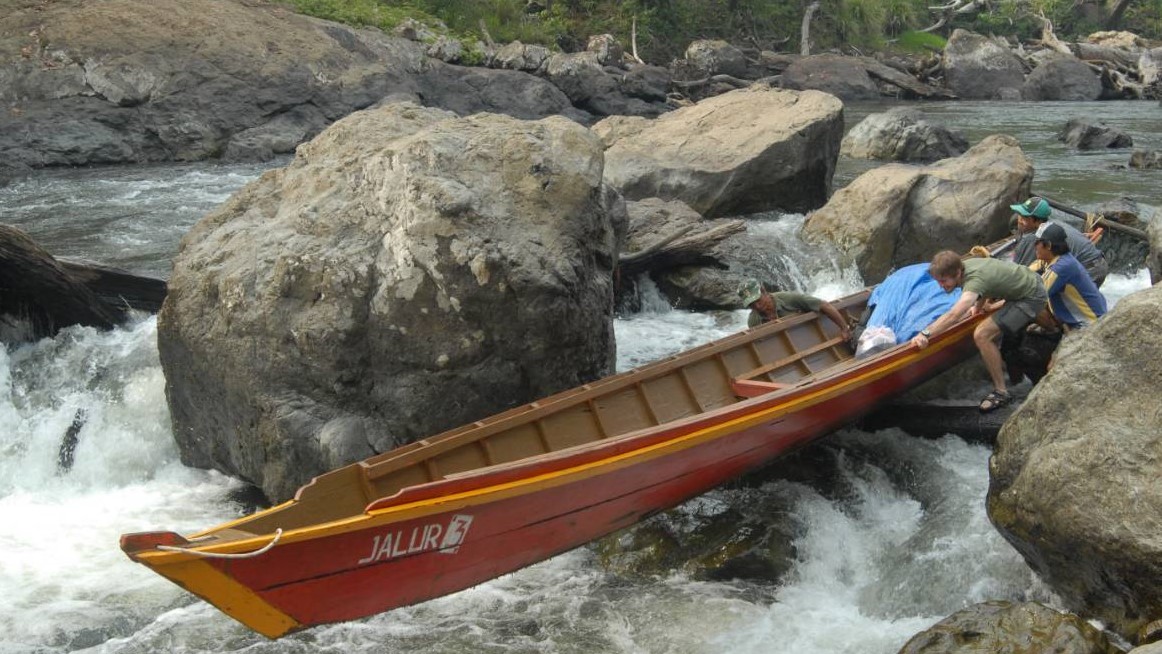
Riam Pulau, Riam Panjang and Riam Jambu respectively. which are situated at a distance giving increasing challenge as the boat passing through them apart from many minor rapids you are going to encounter.This unique challenging rapids adventure is conducted using local boats with highly experienced boatmen to enable the trip. The tour also gives you an outlook of the only area in West Kalimantan that produces diamond apart from gold.You are indeed welcome to try the traditional way of panning gold or diamond during the trip. Observe closely the living cultures and social structures in the jungle. In person you’ll experience the jungle-life and getting to know more people, filling your heart with their cheerful laughter. This adventure tour is only organised in its main features and so it will always be an adventure, which is depending on weather and river conditions...full itinerary
.....................................................................................


Cruising the Kapuas River from Sintang to Kebiau River, Trekking the jungle to
Sabang Laja Village following tracks to Ensait Panjang. There are two Ensait Long-houses : Ensait  Panjang and Ensait Pendek, situated at a distance. We pass through Ensait Pendek and stay overnight in Ensait Panjang. Dinner will be served together with the community and hospitality with the chief. Here we can see how they traditionally weave clothes, plait baskets. Climbing The Mount Kelam from where you can see the Green Flora and Fauna Beauty of Indonesia West Borneo Province.....full itinerary

................................................................

Cruising up to the end of the Mahakam River, you can enjoy an exotic scenary at both sides of the river. You will get through the amazing and dangerous Rapids, between the high Rocky Mountain walls. Our Longboat will bring us to the start point for the trek crossing the Muller Mountains to the Indonesia Province of West Kalimantan. During the Trek you will get Through the unhabitated primary virgin Rainforest, we will fish and hunt meat for our meals. Overnights are in a jungle camp, till we reach Tanjung Lokan village, and cruise down the Kapuas River, passing Putusibau, to reach Pontianak city as the end of this challenging  trek "Cross Borneo". ... full itinerary
 
all rights reserved COPYRIGHT © Gigantara 2008 - 2012
design De'gigant Companies
                                                                                      Join us for a once-in-a-lifetime exploration of Pontianak & Kapuas River Tour of the Kalimantan Island !