|
|
Dayak
Culture Tiwah Event
Tiwah Dayak
Ceremony
Death,
the Dayaks belief, is considered a migration from the world of
the living to the hereafter. Basically, the death ritual is to honor
the soul simultaneously as a means to lead the soul of the dead towards
the hereafter. Therefore, for the Dayaks of Central Kalimantan
especially the Ngaju, the death ritual, called Tiwah is considered of
the utmost importance.
The Ngaju believe that the soul Liaw of the deceased person keeps
lingering in the family's surroundings. Only after the ritual known as
tiwah has been held is the soul free to travel to the hereafter, called
Lewu Liaw or lewu tata.
The death ritual consits of two parts. First, the ceremony which is
held immediately after a person's death. Second, the tiwah, which is to
lead the soul to the other world and concludes the death ritual.
Generally, this ceremony is held a year after the person's death.
Commonly it is held after the harvest season when there are not much
work to do and food stocks are available. However, since a lot of money
is involved, most people usually wait until enough has been saved, or
else organize the event collectively. The ceremony may last for week or
a month, depending on the wealth of the family. The bones are collected
and wrapped in a kakandin (red cloth, placed into a garantung gong),
then stored in the Sandung, the special storage house. All the while,
the gongs and drums are sounded and there is chanting. The Upo or
ceremony leader, speaks a formula, which is repeated by the basirs of
panumba that is, the members of the group perfoming the ritual. The
drums are again beaten, in the rhythm that changes with the mood of the
narration. First, the soul is awakened. Then, it is invited to put on
proper clothes and offered various delicacies. It is also given a new
name.
|
Finally, the soul is led to
the belay entay (waiting house), which is
found on pasahan raung hill (the coffin). After that, the Salumpuk liaw
haring kaharingan are summoned from place named Balu Indu Rangkang.
There are two souls representing the physical and the spiritual. The
souls merge and travel to a place called Banama Nyaho. From there, the
trip continues to Lewu Tata Panungkup.
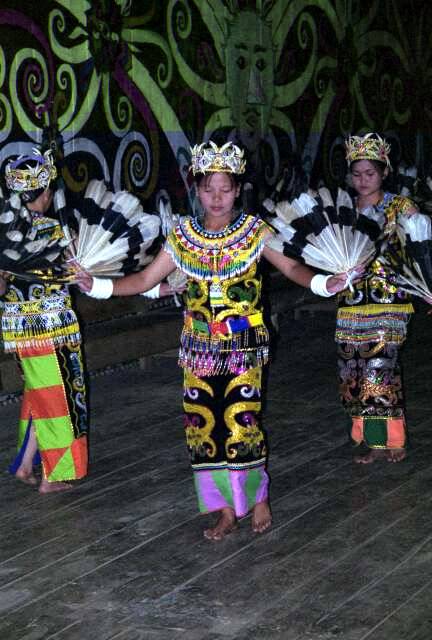
During the tiwah ceremony
people sing and dance with the remains of the
dead during the night. All the people participate, men and women, old
and young. The ceremony reaches its most dramatic stop during the
slaughter of a buffalo as a sacrifice. If only one buffalo is killed,
it is done a day before the cremation. If there are several, the
killing maybe done either at once, or a day before cremation or one or
a few at a time, until cremation takes places. The buffalo is killed
with spears, by several people, taking turns. The animal is tied to the
animals pala, called sapundu and cannot escape, while it's executioners
aim their spears at its head and body.
|
|
| The person who has the
obligation to throw the first spear is the brother of the deceased. If
he is indisposed, he can be represented by a cousin. After the buffalo
is dead, members of family trample on the carcass later, the meat of
buffalo will be shared. Commonly, the ceremony of cremation is held a
day after the ceremony buffalo killing. A cleansing ceremony is held
three of seven days after tiwah ceremony, to drive all the evil spirit
away. All the utensils used in the tiwah are thrown away, because they
are considered to be attached to those evil spirits. The cleansing
ceremony is led by a balian. |
|